

How Does a Rotating Gravity Bong Work? 360° Water Displacement Explained
, by Bret Severson, 4 min reading time
, by Bret Severson, 4 min reading time
How does a rotating gravity bong work? Learn how a 360° dual-chamber design uses water transfer, gravity and displacement to move air through the system.
A rotating gravity bong uses changing water level and water displacement as part of its airflow cycle. Instead of keeping one water chamber fixed, a dual-chamber design changes the position of two chambers so water can move from the upper chamber to the lower one.
The mechanism is mechanical: gravity moves the water, the moving water changes the available air volume inside the chambers, and the system routes that displaced air through its airflow path.
The Gravity Reactor frame is capable of a full 360° rotation. That does not mean one normal water-transfer step requires a continuous 360° spin. During typical operation, the useful transfer happens as the two chambers exchange positions through approximately a 180° turn. Repeating the turn continues the cycle around the full rotational path.
This distinction matters because “360° rotating” describes the range of motion of the frame, while the water-transfer cycle is driven by the chambers repeatedly moving between upper and lower positions.
The second chamber gives the water somewhere to move as the frame rotates. In a fixed single-chamber water bong, the water normally stays in the same reservoir. In a rotating dual-chamber gravity bong, water transfer itself becomes part of the mechanism.
Clear chambers also make the process easy to observe: you can see the water level change as the two chambers trade positions.
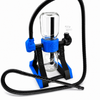
The Gravity Reactor™ 360° Rotating Water Bong uses two removable 16 oz clear glass chambers mounted in an ABS rotating frame. The complete system includes an approximately 5-foot hose, airflow components, seals and gaskets, and a standard 14 mm borosilicate glass bowl connection.
The design is manually operated—there are no motors or electronic controls required for the rotating water-transfer cycle. Complete units are assembled and individually inspected in Wisconsin before shipment.
The simplest mechanical difference is that a fixed water bong keeps its water reservoir stationary, while a rotating gravity bong intentionally moves water between chamber positions. For a fuller comparison, read Gravity Bong vs Regular Bong: What’s the Difference?.
Look for a stable rotating frame, removable chambers, accessible seals, clear setup instructions, and a complete list of included parts. Buyers should also verify the return policy and warranty because a rotating design contains more connection points than a basic fixed glass piece.
If price is a major factor, see our Gravity Bong Under $150 Buying Guide.
A rotating gravity bong works by making water displacement part of the operating cycle. Rotate the dual-chamber assembly, let gravity transfer the water, and the changing water volume moves air through the system. The frame may rotate through 360°, while each normal chamber-transfer step is approximately 180°.
Shop the Gravity Reactor™ | How It Works | Setup Guide | Specifications
The Gravity Reactor™ is intended for lawful adult use only by individuals 21 years of age or older. Buyers are responsible for complying with all applicable local, state, and federal laws.
You must be 21 or older to enter this site.
You must be 21 or older to access this site.